
The Proactive EAP®: A Paradigm Shift
Rethinking the traditional EAP model and what comes next.

In brief
- The traditional EAP model is reactive. It relies on employees recognising they need help and seeking counselling, so support often arrives after problems have escalated.
- Industry research across Australia, the United Kingdom and the United States reports traditional EAP engagement rates averaging around 5%.
- A proactive approach broadens the support pathways alongside counselling. Participation in the Proactive EAP® has typically exceeded 50%, although participation and counselling utilisation are measured differently.
Many organisations see the growing need to better address employee mental health, wellbeing and psychosocial risk. At the same time, many continue to rely on Employee Assistance Programs (EAPs) that were designed decades ago and have changed relatively little, despite significant advances in our understanding of mental health, wellbeing and human behaviour.
Organisations are beginning to ask an important question: could more be done to support our people before challenges escalate into significant mental wellbeing problems?
For more than forty years, EAPs have provided employees with access to counselling when personal or work-related concerns are affecting their wellbeing, behaviour or performance. The traditional EAP model is, however, fundamentally reactive, providing one particular type of service once a person recognises that they need help, sees counselling as potentially useful and is prepared to take the time to commit to it.
Keep reading the full paper
It's free. Add your details and the rest of the paper opens here straight away. We'll also email you the PDF.
Thank you. The full paper is open below, and a PDF copy is on its way to your inbox.
Mental Health Challenges Develop Gradually
According to the World Health Organization (WHO), poor mental health contributes to an estimated 12 billion lost working days globally each year through depression and anxiety alone, highlighting the importance of prevention and early intervention rather than relying solely on treatment after problems have become entrenched.
Most mental health and psychosocial challenges do not appear overnight. They tend to develop over time as challenges appear, personal resources are depleted, challenges persist, distress escalates and mental health symptoms increase. This process tends to undermine confidence, test resilience and erode personal agency.
Research commissioned by SafeWork NSW reported on some of the psychosocial factors that can contribute to psychological harm that can increase the likelihood of mental ill-health over time. The evidence increasingly suggests that intervention is most effective when it occurs early and through multiple levels of support rather than waiting until someone reaches a point of significant stress/distress.
Intervention is most effective when it occurs early and through multiple levels of support rather than waiting until someone reaches a point of significant stress/distress.
Limitations of the Reactive Model
This reality highlights one of the inherent limitations of the traditional EAP model that relies on individuals recognising that they need help, and then actively seeking ‘counselling’. Many of us know from our own experience that seeking help can be difficult. People often delay taking that step, hoping problems will improve on their own or they don’t see counselling as what they need, or see it as a bigger step than they are prepared to take.
This challenge is reflected in EAP utilisation data. Industry research across Australia, the United Kingdom and the United States consistently reports traditional EAP engagement rates averaging around 5%, with many organisations reporting utilisation rates between 3% and 9%.
Low utilisation does not mean employees do not value having professional support available. It does, however, raise an important question: how many employees who could benefit from support are not accessing this particular type of service, and how many are waiting until issues have escalated and become entrenched and so more difficult to resolve?
For organisations, this presents a practical challenge. Organisations that are committed to supporting employee wellbeing see that many employees do not seek counselling until their wellbeing concerns are problematic, impacting their functioning, health and work. In an environment where psychosocial risk management is receiving increasing attention, many organisations are looking for ways to support their people and manage people risks earlier.
Introducing the Proactive EAP®
After years of delivering traditional EAP services, we began asking whether support could be provided differently. What if organisations could help employees earlier, before problems intensified?
What if support was not something people only accessed when they were struggling, but something that helped them stay well, build resilience and navigate challenges more effectively from the outset?
These questions led to the development of Life Street’s Proactive EAP®.
Workplace wellbeing programs are most effective when they combine prevention, early intervention and tailored support strategies.
Importantly, a proactive approach is not about replacing counselling. The counselling component remains a critical part of an effective program. Rather, it is about broadening the support pathways and services for employees.
The Proactive EAP® integrates professional support with digital wellbeing resources, self-guided learning programs, practical tools and early intervention programs designed to help employees develop skills, build resilience and navigate challenges before problems become embedded and more complex. The different types of support are integrated in a custom-built digital system with a focus for employees on usefulness, personalisation, engagement and accessibility.
This approach aligns with growing evidence, such as that summarised in the WHO’s Guidelines on Mental Health at Work, that workplace wellbeing programs are most effective when they combine prevention, early intervention and tailored support strategies.
Different Engagement and Impact
One of the more interesting outcomes of this approach has been employee engagement.
The traditional EAP counselling model commonly has utilisation rates in the single digits. By offering multiple forms of support for different people, and working collaboratively with organisations through HR, People & Culture and Work Health and Safety, participation rates in the Proactive EAP® have typically exceeded 50%.
While participation measures differ from counselling utilisation rates, the broader range of resources and services encourages significantly higher levels of interaction with wellbeing support.
The value of this extends beyond engagement statistics alone. Higher participation means more employees are building practical wellbeing skills, accessing support earlier, developing coping strategies and engaging with resources that are designed to help prevent issues from escalating.
This approach is also relevant for organisations seeking to strengthen their response to psychosocial risk. While no program can eliminate workplace hazards, by helping employees access the right type of help earlier and partnering with the workplace where needed, this approach complements broader efforts to build a psychologically healthy and supportive organisation.
An Important Shift
In many ways, this reflects a broader transformation taking place in workplace wellbeing.
Historically, EAPs were primarily designed as a response mechanism when employees encountered significant difficulties. Increasingly, however, organisations are recognising that wellbeing is not about simply responding to personal crises or mental health symptoms. It is also about helping people maintain resilience, manage challenges effectively and manage their psychological health, especially when it’s tested, as it is for everyone from time to time.
Helping people maintain resilience, manage challenges effectively and manage their psychological health, especially when it’s tested, as it is for everyone from time to time.
The Proactive EAP® represents a significant shift in Employee Assistance Programs. Rather than waiting for employees to reach a point where crisis counselling/treatment becomes relevant, employees are supported and helped earlier and so better.
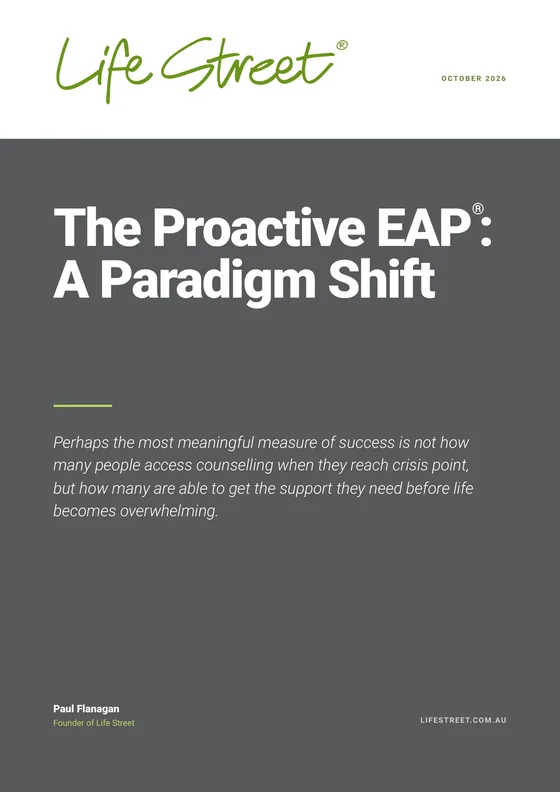
Perhaps the most meaningful measure of success is not how many people access counselling when they reach crisis point, but how many are able to get the support they need before life becomes overwhelming.
The future of employee assistance is unlikely to be defined by counselling alone. Increasingly, organisations are looking for approaches that combine prevention, early intervention, counselling and other support in ways that are engaging, accessible, practical and relevant across their workforce. For some organisations, a proactive program represents an important shift in that direction.